



Menopause-targeted food and drink was worth about $3.2 billion in 2025. Fact.MR market estimate puts it at $7.7 billion by 2036. Most products in this space start with an ingredient. That is the first mistake.
An ingredient can look good in a lab or even in a trial. That does not mean a food built around it will help women with a specific need. Between the study and the shelf sits a translation problem: evidence, dose, format, consumer habits, claims rules and competition. An idea has to clear all six.
Key highlights:
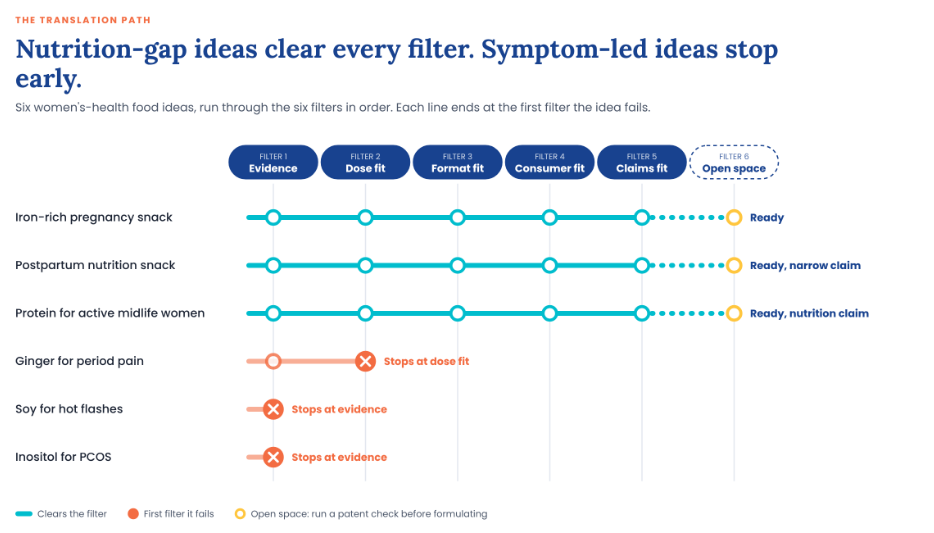
We ran six well-known women’s-health ideas through those six filters. The result is clear.
- Nutrition gaps pass. Symptom claims mostly fail. Products that fill a nutrition need (iron in pregnancy, nutrients after birth, protein for active midlife women) clear most filters. Food is already how they were tested.
- Inositol for PCOS fails on evidence. The 2023 international PCOS guideline calls the evidence limited and inconclusive.
- Soy for hot flashes fails on evidence and claims. EFSA rejected the health claim in 2012. The UK ad regulator banned five menopause and PCOS supplement ads in March 2026.
- Ginger for period pain is stuck on format. The evidence is reasonable, but the tested dose (750 to 2,000 mg of ginger powder a day) is too pungent for most foods without taste-masking.
- The next gains will come from delivery technology, not from new ingredients. Taste-masking, encapsulation and fermentation are where R&D money should go first.
The rest of this article shows how each idea did at each filter, and what that means for an F&B R&D team choosing its next project.
Six filters between a clinical study and a food product
A women’s-health food concept has to clear six filters, in this order. We built them by working backwards from the studies, products and regulator decisions covered below.
- Clinical evidence. There is human evidence for the specific outcome, in the women the product is for.
- Dose fit. The dose used in the trials fits into a normal serving of the food.
- Format fit. The active ingredient survives processing and storage, and the food still tastes right.
- Consumer fit. Women will accept the food and eat it often enough for it to matter.
- Claims fit. The company can legally say what the product does in its target market.
- Open space. The space is not already crowded with products and patents.
A concept that fails any one filter is not ready for food. It may still work as a supplement, or it may need a new delivery technology first.
How six ideas did at each filter
Filter 1: An ingredient being studied does not mean it works for the condition
Inositol is widely sold for PCOS. The evidence is much weaker than the marketing. The guideline’s systematic review pooled 30 trials with 2,230 women. It found benefits for some metabolic measures and possible benefits for ovulation, but no clear effect on other outcomes. It called the evidence limited and inconclusive.
The 2023 international PCOS guideline followed that review. It treats inositol as an experimental therapy for PCOS-related infertility.
Dose is not the problem here. Inositol is a soluble, mildly sweet powder that mixes easily into drinks. The problem is evidence. A food built on a PCOS claim starts on weak ground.
Filter 2: The clinical dose has to fit in a normal serving
Ginger has better evidence for period pain. A 2015 ginger meta-analysis pooled four placebo-controlled trials. Women took 750 to 2,000 mg of ginger powder a day for the first three to four days of their cycle, and pain dropped. A 2024 ginger meta-analysis of 12 trials found ginger beat placebo on pain intensity and duration. It also did about as well as common painkillers (NSAIDs). The trials varied a lot in quality and results, so the size of the effect is uncertain.
The catch is format. Those doses were given as capsules. A team at the University of Aveiro found that ginger yogurts on the market carry too little ginger to matter. At clinical doses, the yogurt became too pungent to eat. Their fix uses cyclodextrin to mask the taste, so far tested only at lab scale.
Filter 3: Needs that were tested as food start ahead
Some trials used food from day one. In Jaipur, 105 pregnant women ate a daily 120 g wheat-and-soy snack. Half got the same snack with 7 g of leaf concentrate added (Jaipur leaf-concentrate trial). In the final month of pregnancy, 37.8% of the fortified group had hemoglobin at or below 8.5 g/dL. In the standard group, it was 83%. The dose fitted inside a normal snack by design.
A larger trial in Delhi gave 816 breastfeeding mothers a daily snack with 600 kcal and 20 g of protein, plus micronutrient tablets (Delhi lactation trial). It did not change infant length at six months, which was its main goal. A follow-up analysis of 600 mother-infant pairs did find higher iron stores, folate, vitamin A and vitamin D in the mothers.
The lesson for product teams is precise. The food moved nutrient levels in the mothers. It did not deliver the bigger outcome. An honest product claim sits at the nutrition level.
Menopause: high demand, mixed soy evidence
Soy isoflavones are the most tested menopause ingredient, and the results are mixed. The Soy Estrogen Alternative trial followed 241 women for two years. They drank soy protein with 42 mg or 58 mg of isoflavones, or a soy drink with the isoflavones removed. Hot flashes fell in all three groups, with no difference between them.
A 2020 soy drink trial with 101 women found no overall effect. Women with severe hot flashes at the start did improve on a medium dose of 35 mg a day. So the answer depends on which women, and how severe their symptoms are.
Biology adds another limit. Only about 27.6% of US women can turn soy into equol, the compound linked to the benefit (Equelle US launch). Otsuka patented a way to ferment soy germ into S-equol, which Pharmavite sells as the Equelle supplement. That solves the conversion problem, but as a tablet, not a food.
Protein for active women is safer ground than “hormone support”
A 2024 protein trial split 55 postmenopausal women into four groups for 12 weeks. Resistance training improved body composition and strength. A high-protein diet without training had only trivial effects.
So the claim a product can defend is “helps you meet your protein needs as part of an active routine.” The claim it cannot defend is “prevents menopause muscle loss.”
Filter 4: Acceptance depends on the country and on the carrier food
A European isoflavone survey asked 465 postmenopausal women in Germany, Denmark, Italy and the UK about isoflavone products. Two things best predicted acceptance. Women who already knew about isoflavones were 2.6 times more likely to accept them. Women who believed food can treat medical conditions were 2.2 times more likely. The authors concluded that products need to fit each country’s food culture.
The carrier food matters as much as the ingredient. In a functional food concept study, the carrier had the largest effect on perceived healthiness and willingness to try. Concepts scored best when the added ingredient naturally belonged in that food.
Postmenopausal women also tend to place functional foods between food and medicine. Many distrust health claims made by food companies (older women’s views).
A food beats a capsule only when it makes women take it more often. A breakfast product, a mid-morning snack or a daily drink can do that. A cookie that copies a capsule cannot.
Filter 5: Claims rules differ sharply by market
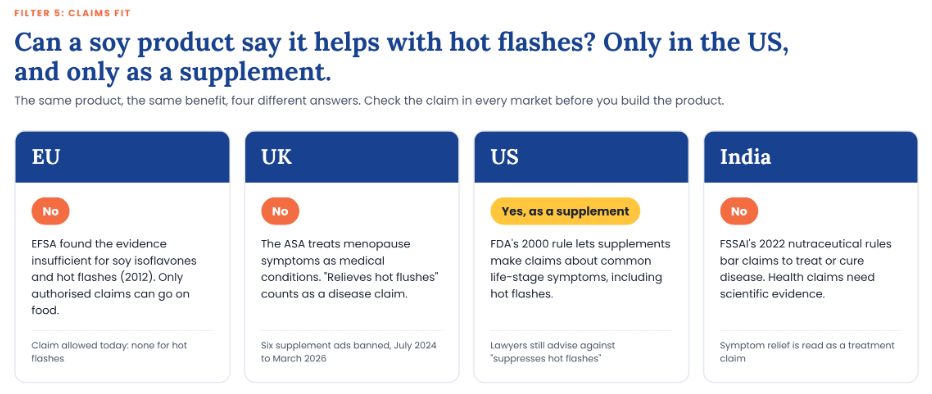
The same soy drink can carry a symptom claim in one country and not in the next.
- EU. EFSA found the evidence insufficient to link soy isoflavones to fewer hot flashes or better bone density (EFSA 2012 opinion). Under EU claims regulation, only authorized claims are allowed. Regulators also look at how much of the food is needed to get the effect.
- UK. In July 2024 the ASA banned a Feel ad that promised relief from hot flushes and night sweats (ASA Feel ruling). It treats menopause symptoms as medical conditions, so “relieves hot flushes” counts as a disease claim. In March 2026 it banned five more ads, including ones for Lunera and Nova Menopause Vitality (ASA Lunera ruling, ASA Nova ruling).
- US. FDA’s structure/function rule lets dietary supplements make claims about common symptoms of life stages. Hot flashes linked to menopause are one example. Lawyers still warn that “suppresses hot flashes” may cross the line (menopause claims guidance).
- India. FSSAI’s 2022 nutraceutical rules bar claims to treat or cure disease. Health claims need scientific evidence (India claims guide).
Dose and claims are linked. If the effective dose does not fit in a normal serving, an EU claim fails even when the science holds.
Filter 6: The open space is in delivery, not ingredients
The ingredients themselves are crowded. Large players are moving in. Nestlé ran its first women’s-health innovation challenge for start-ups in 2025 (Nestlé start-up challenge). Bonafide’s non-hormonal menopause range is now in more than 1,800 Target stores (SIAL women’s health).
The delivery layer is where patents are building. One recent Chinese patent on low-pungency ginger microcapsules for drinks lists five earlier Chinese patents on ginger capsules and gingerol liposomes (CN117225316B ginger microcapsule). Otsuka holds the fermentation route to S-equol. Vital Technologies sells an encapsulated ginger extract (GingerCSR) aimed at bars and shakes (GingerCSR ingredient).
A full patent count per need is the next step for any team that picks a concept. That count shows whether the delivery route you need is open or already fenced.
The scorecard: nutrition gaps are ready, symptom claims are not
Three ideas are ready for food now, two of them only with a narrow nutrition claim. Ginger needs delivery technology first. Soy and inositol are not ready as condition-led foods.
| Concept | Evidence | Dose fit | Format fit | Consumer fit | Claims fit (EU/UK) | Verdict |
|---|---|---|---|---|---|---|
| Iron-rich pregnancy snack | Pass: hemoglobin protected in a 105-woman trial | Pass: 7 g in a 120 g snack | Pass | Partial: tested in a supported programme | Partial: nutrient claims only | Ready |
| Protein for active midlife women | Partial: helps alongside training, trivial alone | Pass | Pass | Pass | Pass for a protein-needs claim | Ready, with a nutrition claim |
| Postpartum nutrition snack | Partial: nutrient levels up, infant growth unchanged | Pass: one 600 kcal snack a day | Pass | Partial: mothers chose from several snacks | Partial: nutrient claims only | Ready, with a narrow claim |
| Ginger for period pain | Partial: 12 trials, mixed quality | Fail in most foods at 750 to 2,000 mg | Fail without taste-masking | Not yet tested | Partial: US supplement claim only | Needs delivery technology |
| Soy for hot flashes | Fail: mixed; helps some women with severe symptoms | Pass in soy drinks | Pass | Partial: varies by country | Fail: EFSA rejected the claim | Not ready |
| Inositol for PCOS | Fail: limited and inconclusive | Pass | Pass | Partial | Fail: UK banned a PCOS supplement ad in 2026 | Not ready |
The pattern is consistent. Where food was part of the trial, the idea clears most filters. Where food is only a carrier for a drug-like effect, it fails on evidence, dose or claims.
Three kinds of opportunity, and what to do with each
Each women’s-health idea falls into one of three groups. Each group needs a different next step.
- Science-rich, product-poor. The evidence is good and the food format works, but few products exist. Pregnancy and postpartum nutrition sit here. Next step: formulation work and a check of who already sells in your markets.
- Product-rich, evidence-poor. Shelves are full, but the evidence does not support the claim being made. Soy for hot flashes and inositol for PCOS sit here. Next step: a claims and evidence audit before any launch. Expect to sell on taste and nutrition, not on symptoms.
- Science-rich, format-poor. The evidence is reasonable, but dose, taste or stability blocks food delivery. Ginger for period pain sits here, and equol sits close by. Next step: scout delivery technology. Taste-masking, encapsulation and fermentation are the tools.
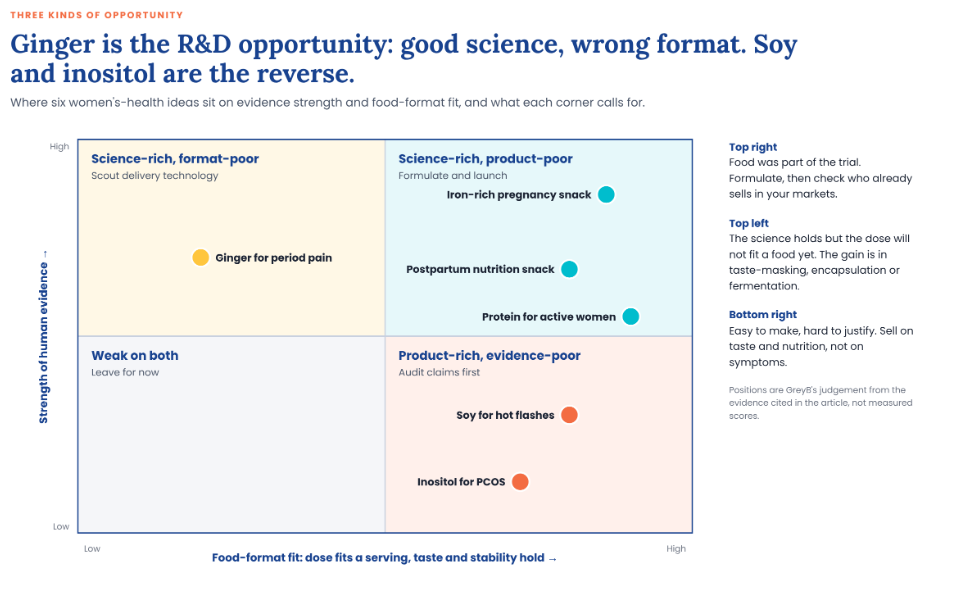
The third group matters most for R&D teams. The breakthrough there is not a new ingredient. It is the delivery method that turns a capsule dose into a food people want to eat. The Aveiro cyclodextrin yogurt, encapsulated ginger extracts and Otsuka’s S-equol fermentation all show that path.
Four rules for your next women’s-health concept
- Start with the need, not the ingredient. Name the women, the symptom or gap, and the outcome before you pick anything to add.
- Work back from the clinical dose to the serving. If the tested dose does not fit in a normal portion, you have a delivery problem, not a product.
- Give the food a reason to be food. It should fit a meal or habit that women already have.
- Clear the claim before you build the product. Check what you can say in each market you plan to sell in.
What are crucial next steps?
The sixth filter is the one most teams skip. Before you commit a formulation budget, you need to know who already owns the delivery route you need.
GreyB maps the patents, products and start-ups around a specific women’s-health concept. Its research experts tell you whether the space is open, crowded or fenced.
How Can GreyB Help You?
We support industry-leading R&D and Innovation professionals through complex problems. Describe your challenge, and let us bring clarity and expertise.
How Can GreyB Help You?
We support industry-leading R&D and Innovation professionals through complex problems. Describe your challenge, and let us bring clarity and expertise.