



So far, glycerol-based hydration has been commercialized mainly in the supplement market. Niche and mid-size brands have sold it through powdered and liquid sports nutrition formats. Glycerol has not yet crossed into mainstream ready-to-drink hydration at scale. But PepsiCo may change that.
In less than a year, the beverage leader has run three clinical trials on glycerol-based hydration. This looks like formulation de-risking for a commercial launch. PepsiCo may be preparing to move the mechanism into a much bigger market.
The company has also announced plans to launch Gatorlyte Longer Lasting by 2027. The positioning of this ready-to-drink hydration product is about helping the body retain fluid and stay hydrated longer than water. Although PepsiCo has not disclosed the formula, the claims point toward the same fluid-retention mechanism that glycerol is known for.
Our webinar maps all such leading-player moves, clinical trials, and product launches that are shaping the glycerol-based hydration market.
What PepsiCo’s Three Trials Actually Reveal About Glycerol-Based Hydration Formulation
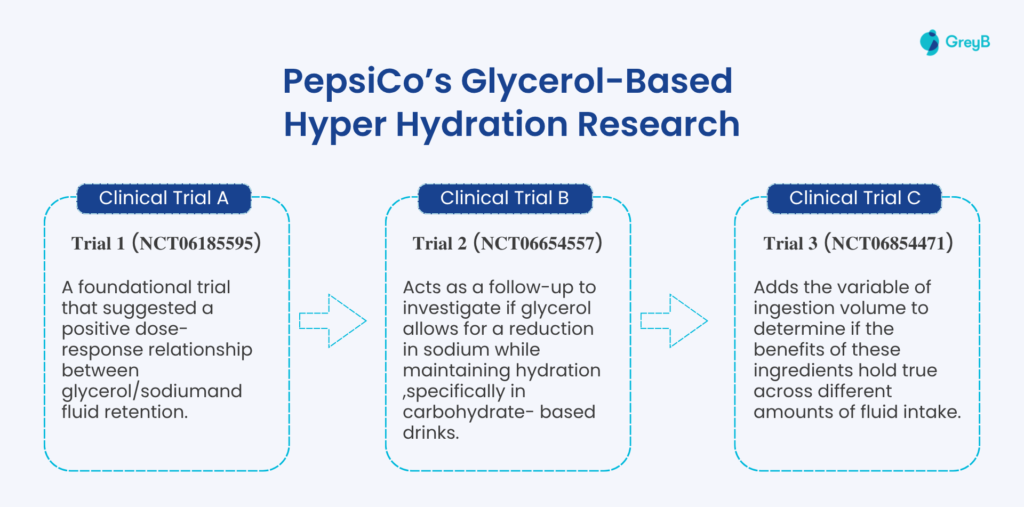
The foundational trial established the dose-response relationship between glycerol and sodium concentrations and fluid retention at rest. In the second trial, PepsiCo investigated whether glycerol enables sodium reduction specifically in carbohydrate-based drink formats. In the third trial, PepsiCo checked whether the hydration benefits of sodium and glycerol remain consistent when people consume different amounts of fluid. Each trial isolated exactly one new formulation variable.
The progression is clean. Establish a mechanism, optimize the sodium formulation, and validate the dosing range. This strongly suggests that PepsiCo is actively developing and refining a
new hydration product or formula for a potential launch.
However, the most strategically important finding in PepsiCo’s supporting science is not that glycerol improves hydration; that was known. It is which carbohydrate co-variable matters, and which one does not.
Isomaltulose can increase a drink’s hydration score by about 45% compared with glycerol and sodium alone
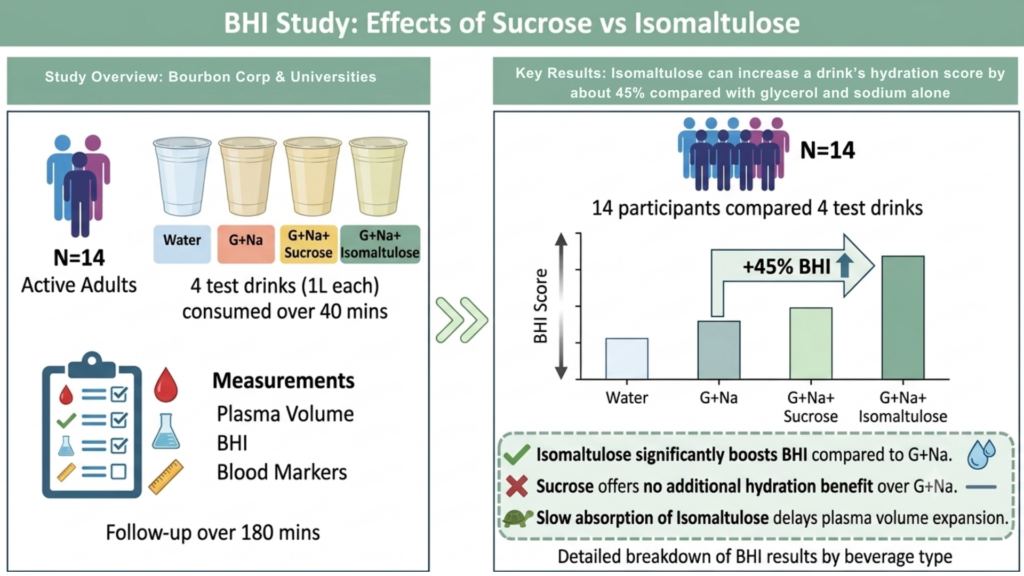
Japanese food manufacturer Bourbon Corp, in collaboration with five universities, conducted a trial to study the effects of sucrose versus isomaltulose on the Beverage Hydration Index (BHI).
The main focus of the study was to understand whether adding sucrose or isomaltulose to a glycerol-sodium beverage could increase the Beverage Hydration Index (BHI). Sucrose is a fast-absorbing carbohydrate, while isomaltulose is absorbed more slowly.
In the trial, 14 active adults consumed 1 liter of four different test beverages over 40 minutes. These included water, glycerol plus sodium, glycerol plus sodium plus sucrose, and glycerol plus sodium plus isomaltulose. The researchers then assessed changes in plasma volume, BHI, and blood markers over 180 minutes.
The study found that adding isomaltulose increased BHI by approximately 45% compared to glycerol plus sodium alone. In contrast, sucrose did not provide any additional hydration benefit. Isomaltulose also delayed plasma volume expansion, which was likely due to its slower absorption rate.
Glycerol is also being explored for masking bitterness in beverages containing caffeine and cognitive ingredients. At the same time, companies are filing patents around solid and reconstitutable glycerol drink formats. Slate brings these signals together across patents, papers, and clinical studies, so you can see where the category is moving before it becomes obvious. Ask Slate: “What are the latest advancements in glycerol-based hydration beverages?”
What are the latest advancements in glycerol-based hydration beverages?
Glycerol can reduce caloric cost, oxygen cost, heart rate, and exertion
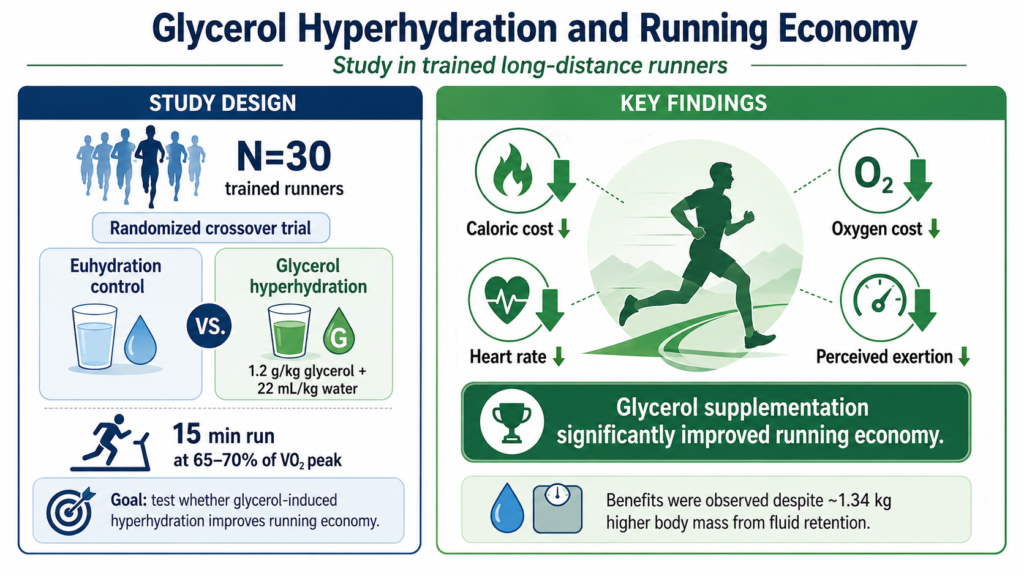
The clinical trial studied the impact of glycerol-induced hyperhydration on running economy in trained runners. Running economy refers to how efficiently a runner uses energy and oxygen while running at a given speed.
The study included 30 trained runners who participated in a randomized crossover trial. The researchers compared two conditions: a euhydration control state and a glycerol hyperhydration state. In the glycerol condition, participants consumed 1.2 g/kg of glycerol along with 22 mL/kg of water. They then ran for 15 minutes at a speed equal to 65–70% of their VO₂ peak.
The results showed that glycerol supplementation significantly improved running economy. It reduced caloric cost, oxygen cost, heart rate, and perceived exertion during the run. These benefits were observed despite a significant increase in body mass of approximately 1.34 kg due to fluid retention.
Current Product Landscape on Glycerol-based Hydration
Currently, glycerol-based hydration is concentrated mainly in sports nutrition rather than mainstream RTDs. Niche to mid-sized supplement brands are competing in the market.
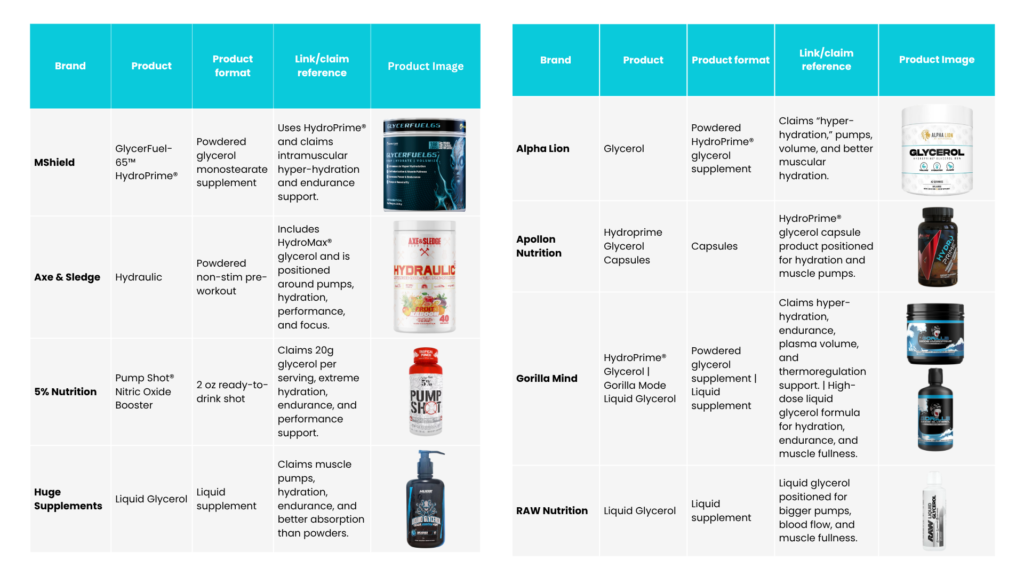
Develop In-House or Source? Three B2B Glycerol-Based Ingredients Available Now
Brands do not need to develop glycerol ingredients from scratch. Three commercial-grade B2B glycerol powders are already available:
- HydroPrime® by NNB Nutrition: It is a 65% glycerol powder known for strong stability in current humidity testing. Its use in products such as MShield’s powdered supplement and Apollon Nutrition’s glycerol capsules shows its suitability for different supplement formats.
- HydroMax® by Glanbia Nutritionals: The first high-yield 65% glycerol powder to reach the market. It has an established supply chain and is already familiar to formulation teams across the sports nutrition sector. Axe & Sledge used it in its pre-workout powder.
- GlycerPump® / GlycerSize by Pinnacle Ingredients: It was originally launched as GlycerPump by Australian innovators, rebranded as GlycerSize in 2018. A 65% glycerol powder with a multi-year commercial track record in endurance supplements.
All three ingredients are already in active use. Glycerol has GRAS status in the US and is approved in the EU, China, and Australia. There is no novel-food barrier, no market-specific dossier requirement, and no long approval timeline to manage. With the right formulation, clinical substantiation strategy, and consumer positioning, a brand can move directly into product development.
The main constraint is consumer targeting. Currently, brands are using glycerol in hardcore sports nutrition, pre-workout, and pump supplement portfolios. HydroPrime® by NNB Nutrition itself is positioned as a stable glycerol form designed to address clumping and stability issues in glycerol-based powdered products. This validates glycerol’s performance appeal. But its use remains narrow in hydration beverages for everyday consumers.
A 2025 study reported approximately 1.4 kg of temporary body mass gain per session due to glycerol-driven fluid retention. For performance athletes preparing for a marathon or triathlon, this may be an acceptable training or race-day trade-off. However, for everyday consumers, this temporary weight gain could become a concern.
Where are the next white spaces in hydration beverages?
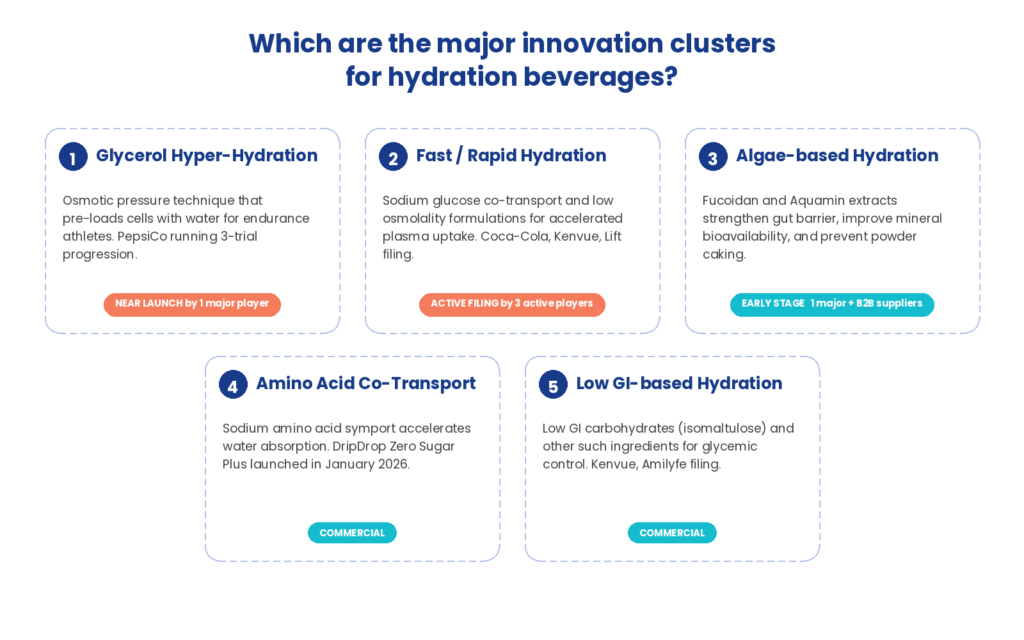
Glycerol hyper-hydration has already entered the red-ocean zone on the competitive density map. But entry is still possible. B2B glycerol ingredients are already available for brands that want to build in this space. Beyond glycerol hyper-hydration, four more hydration mechanisms are gaining attention: fast or rapid hydration, algae-based hydration, amino acid–based formulas, and low-GI hydration. Patent activity shows that leading beverage brands are already moving in the fast or rapid hydration segment.
We have mapped these alternative hydration mechanisms to patent landscapes, clinical data, or consumer demand. Fill out the form and watch the webinar to see which mechanisms are getting crowded, which windows are closing, and where brands still have room to act.