




27 of the world’s largest CPG companies, including Nestlé, PepsiCo, and Mars, are simultaneously pursuing color reformulation programs under the FDA’s voluntary 2026 synthetic dye phase-out.
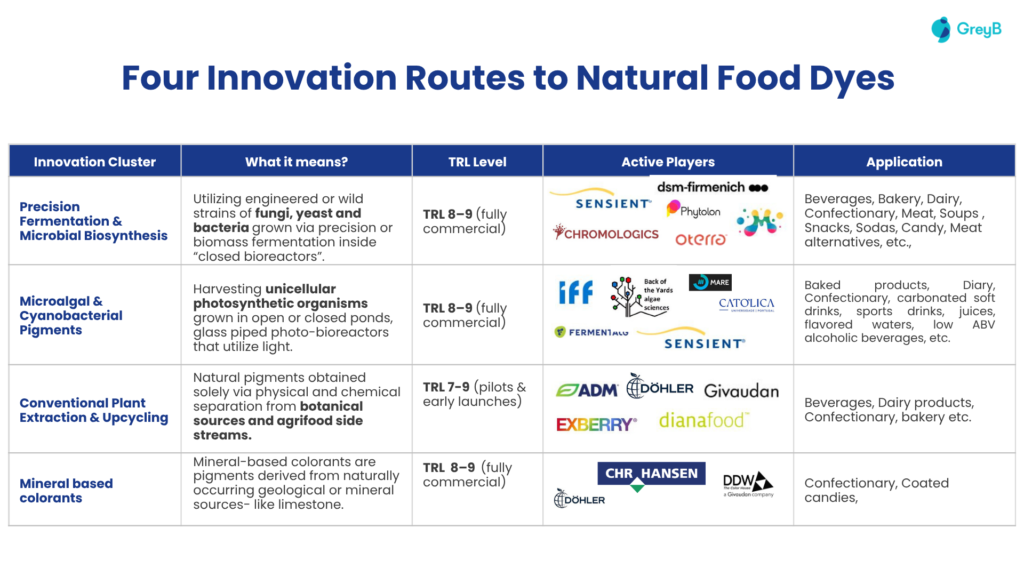
Four innovation routes are emerging for making potential replacements: Precision Fermentation, Botanical Extraction & Upcycling, Algal and Cyanobacterial Biomass, and Mineral-Based Colorants.
Each route brings its own advantages. Algal biomass is emerging as a strong option for blue and green color applications. Microbial fermentation is on the way to closing the 3 to 10x cost gap between natural and synthetic dyes. Meanwhile, mineral-based pigments offer the advantage of lower cost and stronger supply security.
However, no single technology approach can solve the reformulation challenges across all product categories. The right choice will depend on various factors like product format, stability requirements, target markets, and the timeline for implementation.
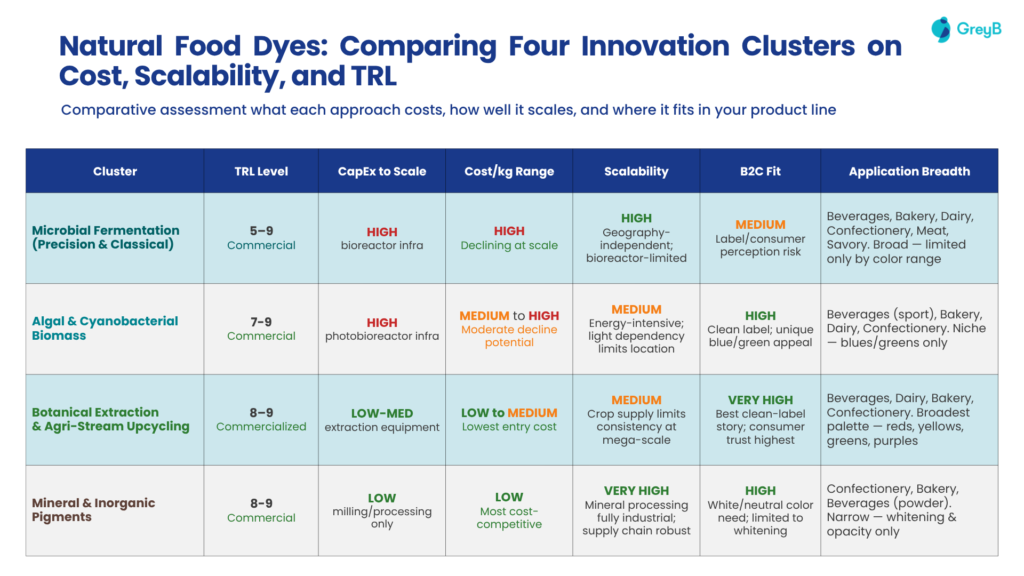
Our food experts had a lengthy discussion on the state of the art in this space. They compared the four innovation routes across five factors that determine the potential for large-scale reformulation: capital expenditure required to scale, cost-per-kilogram trajectory, scalability ceiling, competitor activity, and application formats.
Listen to full conversation using the form below:

Precision fermentation & microbial biosynthesis is pushing natural colors toward cost parity
Natural colorants currently cost 3 to 10 times more per use than synthetic dyes, and fermentation is the only route where this gap is actively shrinking as production scales. Unlike plant-based sources, it does not depend on harvest seasons. This makes it more reliable and flexible in terms of production location. It can support a wide range of applications, including beverages, confectionery, dairy products, meat alternatives, and savory foods.
However, this pathway may face labeling challenges because of GMO-related concerns in EU markets.
Companies like Oterra, BASF, and dsm-firmenich are scaling a red-orange plant pigment called beta-carotene using established microbial hosts such as Blakeslea trispora and Monascus. These organisms have a longer history of food use and regulatory evaluation, while newer fermentation-based colors produced through engineered microorganisms can face questions around GMO status, labeling, and consumer acceptance.
Meanwhile, colours like blues and greens through fermentation are still in the pre-commercial or research stages.
Additionally, high bioreactor investment limits mid-scale manufacturers’ ability to enter the market. Companies can reallocate bioreactors from other processes to make natural food dyes. Or they can partner with a fermentation colorant startup.
But picking the right startup takes work of its own. You need to check their technology maturity, production scalability, cost competitiveness, and regulatory and labeling readiness in your target markets. Our startup scouting services are built to do exactly that.
Oterra and Debut Bio have partnered to scale a natural Red 40 alternative
The partnership scales Debut’s patented cell-free enzymatic manufacturing process. The goal is to create a full palette: orange, red, and violet shades.
In traditional fermentation, the microbe stays alive and makes the target molecule inside its own cell. However, Debut only uses the cell to manufacture the enzyme first. Once the enzyme is isolated, the actual chemical reaction happens outside the cell, in an engineered reactor.
The core advantage is that each reactor runs its own conditions. Temperature, pH, oxygen level, flow rate, pressure, and residence time can all be set independently, reactor by reactor, and sensors monitor each one. This matters because enzymes in the same production pathway often need very different environments to work well.
The companies are designing the final color to be compatible with vegan, kosher, and halal certifications. Additionally, the process is expected to use less land and water than traditionally cultivated red colorants.
Two things worth flagging for reformulation planning. First, this is not a near-term option: the partners are targeting roughly three years to a commercially scaled product, and an FDA approval filing is still ahead of them, not behind them. Second, because the enzymes are still produced upstream using genetically engineered microbes, even though the color-making step is cell-free, this route could face the same GMO-labeling scrutiny in EU markets that other fermentation-based colors face.
DSM-Firmenich is betting on precision fermentation with lead investment in Octarine Bio
Octarine’s PurePalette platform uses genetically engineered microbes and precision fermentation to produce pigments from renewable, bio-based feedstocks. Each engineered strain is designed to produce one specific color.
The company describes PurePalette as the only fully bio-based platform able to deliver the complete color spectrum through a single production process.
In January 2026, Copenhagen-based Octarine Bio raised $5.8 million, bringing its total Series A funding to $15 million. The round included The Footprint Firm, Edaphon, Unconventional Ventures, DSM-Firmenich Ventures, Oskare Capital, and angel investors.
The company is scaling three flagship colors this year: PurePurple, PureGreen, and PureBlue. However, the pigment has not yet been linked to commercial food launches. Octarine has already produced 100 kg of its first flagship pigment. The new funding is meant to bring the second and third colors to the same production stage, with most near-term work going into formulation and product development alongside commercial partners.
Fermentation is an application-agnostic route. But it is not yet ready for widespread use across the full color range. It can also leave behind compounds that create unwanted tastes or smells. These may need to be masked through encapsulation, which adds cost and development time. Most precision-fermented colors are still pre-commercial. This means companies choosing fermentation today are largely making a 3-to-5-year investment. Or, they can simply choose from the few options already available commercially, such as fungal beta carotene or the recently FDA-approved beetroot red produced using yeast fermentation.
Botanical extraction and agri-stream upcycling supports clean-label formulations
The route offers one of the broadest color ranges, including reds, yellows, greens, and purples.
However, extraction costs remain high because of factors such as solvent use, waste management, and regulatory requirements. Companies are working to reduce these challenges through technologies such as microwave and ultrasound extraction. It can improve pigment yield while reducing solvent use. Organic acid stabilization and encapsulation techniques are also being used to improve shelf life and increase heat stability.
Established suppliers, including Oterra, GNT Group, and Givaudan, have developed vertically integrated supply chains using fruit, vegetable, and seed-based sources.
Another challenge with botanical extraction is achieving consistent scalability while maintaining pigment quality across large production volumes.This is because natural crop sources can vary from batch to batch. In addition, this route cannot produce acid-stable blue colors, even with further development.
GNT Group uses purple carrot anthocyanins to create orange-red hues, without color-modifying chemicals

Purple carrot has long been considered a fallback for grape skin extract, the most common source of natural bluish-red color in food. But purple carrot has two problems. It naturally gives an orange-ish hue rather than the deep bluish-red that formulators want. And that color is unstable across the pH range most food and beverage products fall into.
GNT addresses both problems by heating purple carrot material under controlled conditions, adjusting moisture, temperature, and processing time. This eliminates the need to chemically modify carrot pigments or add stabilizers.
The patent describes treatment conditions ranging from 30–90°C for 2 hours to 30 days to achieve the desired orange-red shade while improving color stability. It raises pH stability from roughly 60–70% to at least 75%, and in some cases up to 90%.
The resulting material can be used directly or processed into extracts, concentrates, powders, granules, or flakes for food and beverage applications.
| Analyst Comment: Fermentation is the only route with strong potential to reduce cost per kilogram as production scales. Botanical extraction depends on agricultural inputs, which are influenced by crop availability, land use, weather conditions, and natural variation in pigment content. This limits how much costs can decline over time. In contrast, fermentation can benefit from improved microbial strains, higher production yields, and optimized manufacturing processes. For companies reformulating products today, this creates a long-term strategic choice. Botanical extraction may provide the faster replacement, but it can lock companies into a relatively stable cost structure. If fermentation reaches commercial scale and achieves cost parity, it could become a lower-cost alternative before the next major reformulation cycle, forcing companies to reconsider their ingredient choices again. |
Algal and cyanobacterial biomass route is emerging as a niche solution for blues and greens
Algal and cyanobacterial biomass addresses a key limitation of plant-based colors: producing stable blue and green shades. Spirulina-derived phycocyanin has emerged as one of the most commercially established natural blue colorants, with FDA approval enabling its use across beverages and several other food categories.
The main challenge is production cost. Growing algae in photobioreactors requires high energy input and significant capital investment, which limits how quickly and where production can scale. Phycocyanin, the blue pigment extracted from spirulina, currently costs around $250 per kilogram because of the infrastructure and processing needed to achieve commercial-grade purity.
There are also sensory challenges. The strong algal smell and grassy taste of these pigments can limit their use across different food applications. Companies are developing flavor-neutralization and encapsulation technologies to reduce these issues and expand the use of algal colors in neutral-tasting products such as dairy alternatives and beverages.
Sensient Marine Blue Capri enables stable blues, greens, and purples in low-pH beverages
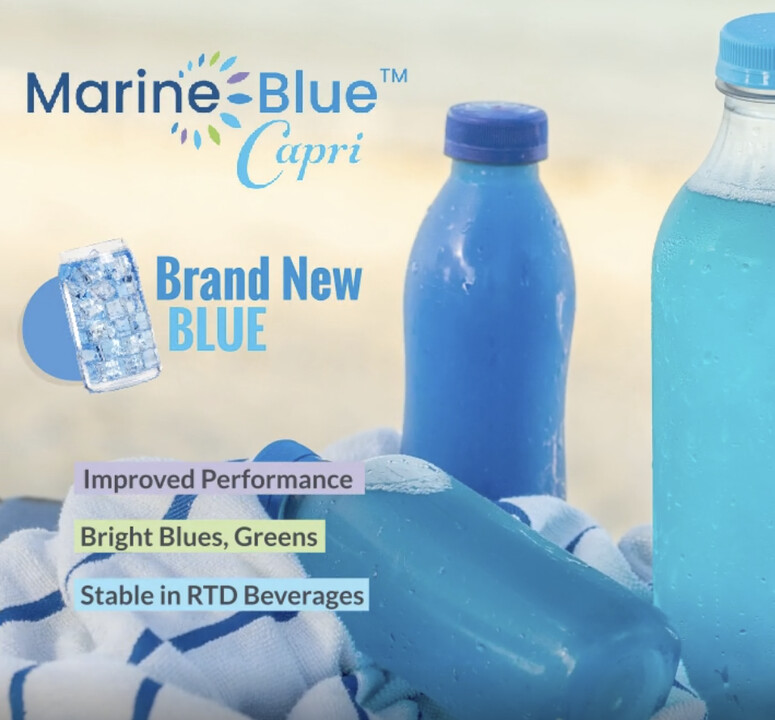
Sensient’s Marine Blue™ Capri is a bright, stable blue color developed for beverages with low pH and exposure to light. It provides a clear blue shade while keeping precipitation in the final product to a minimum. The color can also be blended with yellow or red to create green and purple shades. It can be used in soft drinks, teas, energy drinks, juices, alcoholic beverages, flavored waters, and liqueurs.
Marine Blue Capri remains stable in high-water and low-pH conditions and maintains its color when exposed to light. It also has better heat stability than standard spirulina-based colors. The ingredient supports clean-label formulations and is Kosher, Halal, and Non-GMO.
Sensient has not disclosed the specific stabilization method used in Marine Blue Capri. However, some of its patents describe encapsulation methods for improving the stability of different color extracts, including spirulina.
Mineral-Based Colorants Are Getting Closer to TiO₂-Level Whiteness
Mineral and inorganic pigments are currently the lowest-cost route and offer strong supply security. However, they are mainly suited for producing white colors.
The EU ban on titanium dioxide (TiO₂) and growing FDA scrutiny have pushed companies to reformulate products quickly. Calcium carbonate, calcium sulfate, and calcium phosphate are being used as alternatives to TiO₂ in applications such as confectionery printing, pan-coated candies, and powdered beverage systems.
The main limitation is opacity. No natural mineral currently matches the strong whitening and covering power of TiO₂, which can reduce the visual appeal of the final product.
Calcium carbonate also creates another challenge. When it reacts with acids, it can release gas and create rough surfaces in pan-coated products like candies, nuts, tablets, and pills. Manufacturers must control particle properties and coating chemistry to prevent surface defects.
One industry solution is surface-modified calcium carbonate. Coating CaCO₃ with stearate helps reduce its reaction with acids and improves its use in coated confectionery products.
Mars has replaced its TiO₂-based white ink for M&M’s and Skittles
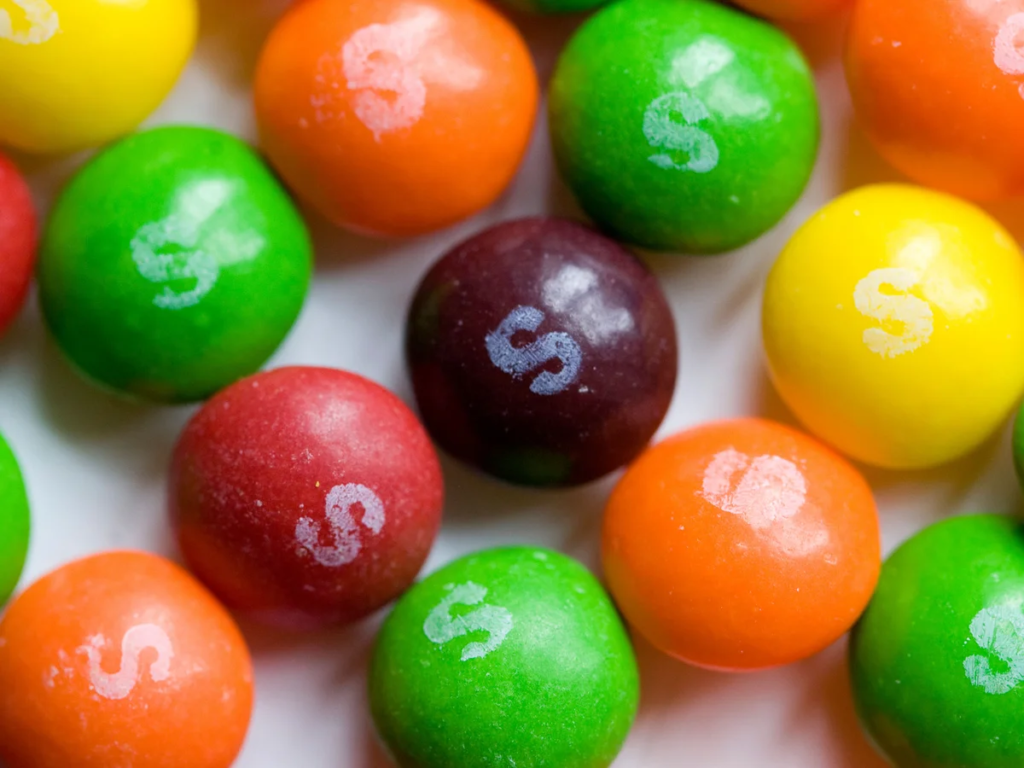
Mars has developed an edible ink that uses scalenohedral calcium carbonate particles as a direct alternative to titanium dioxide (TiO₂). The formulation is designed for printing on confectionery products and could also be used across candies, bakery products, chocolates, supplements, and coated snacks.
The calcium carbonate-based ink provides high whiteness and opacity. It also offers better print quality, resolution, and durability than earlier calcium carbonate inks.
The ink can be applied to coatings, shells, or glazes. For products with fat-based or yogurt-based coatings, an optional protective glaze can also be added.
In 2025, Mars successfully removed titanium dioxide (TiO₂) from its U.S. Skittles line, following nearly a decade of regulatory scrutiny and advocacy over potential safety concerns.
Mars’ testing of a calcium carbonate-based coating on M&M’s and Skittles suggests that the company may be exploring the technology for more than one product. The formulation could support a wider move away from TiO₂ across its confectionery portfolio. This is especially relevant for products like mint and chewing gums that need similar whiteness, opacity, and print quality without using titanium dioxide.
Fermentation Is the Strongest Bet, and the Window to Move Is Shorter Than It Looks
For companies managing products across multiple formats and markets, fermentation currently offers the clearest path toward reaching cost parity across a wider portfolio.
Botanical extraction and mineral pigments are already mature categories, with suppliers who have spent decades building strong IP portfolios, established supply chains, and deep customer relationships. R&D teams betting on these routes are choosing proven, lower-risk technology, but with less room to negotiate exclusive terms, custom formulations, or preferential pricing from suppliers who already hold the leverage.
Fermentation and algal routes have fewer established players and lower competitive pressure. Because the technologies are still developing, R&D teams that move now have more room to shape formulations, secure early access to emerging colors, and lock in supplier relationships before the field fills in.
Among these routes, fermentation has the strongest commercial case. Natural colorants currently cost 3 to 10 times more per use than synthetic dyes, but fermentation is the only route where this gap is actively shrinking as production scales.
One of the clearest signals for R&D teams weighing their timeline comes from Oterra, the world’s largest standalone natural color company. Oterra has partnered with a precision fermentation startup specifically to develop a fermentation-derived alternative to Red 40. When a supplier of this size moves to secure a fermentation partnership, it signals that the best technology positions and partners in this space are starting to get claimed, narrowing the options available to R&D teams who wait.
The opportunity in fermentation is still open, but the window may be smaller than it looks. Anchoring only to the 2026 synthetic dye phase-out deadline can create a false sense that there’s time to keep observing the market. In practice, teams that wait risk finding that the strongest technology partnerships have already been secured by competitors who moved first.
Conclusion
No single route works for every product. The right choice depends on the product format, stability requirements, target markets, and reformulation timeline. In many cases, companies may need to combine more than one route across their portfolio.
For carbonated beverages, it’s worth evaluating proprietary algal blue platforms alongside fermentation-based approaches, since these have solved for off-taste through encapsulation or flavor-masking. Heat-processed foods and low-pH products need better pigment stability, especially for botanical colors. Whitening applications already have mineral-based routes available today. And for companies managing products across multiple formats and markets, fermentation currently offers the clearest path toward reaching cost parity across a wider portfolio.
We have already mapped the natural color landscape across these factors. This includes which approaches work best for different product types, where important supplier relationships and patent positions are developing, and how the regulatory filing landscape differs across major markets.
Fill out the form and watch the webinar to understand which route, or combination of routes, best fits your products.