



White poison – that’s how Professor John Yudkin described sugar when discussing its ill effects in his book “Pure, White and Deadly.” Sugar can induce serious ailments such as hypertension, type 2 diabetes, and cardiovascular disease.
The World Health Organization (WHO) strongly recommends that adults and children reduce their free sugars intake to less than 10% of their total energy intake, ideally around 5%. 70% of consumers worldwide, now better informed, seek low-sugar products or ones with alternative sweeteners.
However, most companies in the sweets and dairy industry are struggling to reduce sugar content while preserving the taste and texture of their products. While solutions to maintain the taste and texture in sugar reduction are available, they have their own downsides.
Different Mechanisms Deployed for Sugar Reduction
Substitutes and sugar modification are the most popular sugar-reduction mechanisms under research. Each targets a specific problem, but the goal is to make reduced-sugar products as acceptable as sugar ones.
Sugar substitutes
One of the most prominent methods of reducing sugar content is to replace the sugar with alternative sweeteners such as Stevia, Sugar Alcohols, Allulose, Tagatose, etc. However, most alternative sweeteners come with their own challenges, such as a bitter aftertaste or a lingering flavor profile. Sometimes, these also affect functional properties such as bulking, browning, or caramelizing (needed for adding flavor and texture), and thus their use is limited in certain products.
Different types of sugar substitutes: High-Intensity Sweeteners. They possess a sweet taste but are non-caloric, provide no bulk to food, and are sweeter than sugar. Therefore, they are used at very low levels. There are three primary forms of high-intensity sweetening agents:
- Synthetic sweeteners, such as Aspartame and Sucralose,
- Semi-synthetic sweeteners, such as Neohespiridine dihydrochalcone,
- Natural options, like Fruit sugars(Brazzein), Stevioside, Glycyrrhizin, and Thaumatin
Bulk Sweeteners: Ingredients that are about as sweet as sugar and take up about the same volume are called bulk sweeteners. Bulk, like sugar, has relatively low sweetness considering its volume and is therefore needed in greater quantities. There are two main categories of bulk sweeteners:
- Caloric – Sucrose, Molasses, Maple Syrup, Glucose, and Fructose
- Low-Caloric – Sorbitol, Xylitol, Erythritol, Allulose, and Tagatose
Sugar modification
Sugar reduction can also be done by modifying the sugar (milk or added sugars). This technique includes modifying the structure of existing sweeteners to achieve the desired nutritional and taste properties. These solutions might also work by blocking specific taste receptors to mask and/or amplify sugary tastes. Thus reducing the need for added sugars. This report will focus on allulose and tagatose as sugar alternatives. Additionally, let’s explore whether the modification technique of converting milk sugar to GOS can effectively replace cane sugar.
Is Allulose the best alternative to sugar?
Allulose is a low-calorie sweetener with the chemical name – d-psicose. It is a naturally occurring monosaccharide but rare, which gives it the name ‘rare sugar.’ It was initially identified from wheat and has since been found in certain fruits, including jackfruit, figs, and raisins.
Benefits of using Allulose as a solution to the sugar reduction problem
- Tastes like sugar – Unlike stevia, monk fruit, and erythritol, Allulose is chemically similar to table sugar. So, they have almost the same taste profile.
- Used in bulk, like sugar – Allulose is about 70% as sweet as sugar, meaning a little more would be needed to substitute for sugar. So, it adds bulk and texture.
- 1/10 calorie intake – One of the critical properties of Allulose is its caloric value. It’s just 0.4 calories per gram, which is one-tenth of the calories in sugar.
- Diabetes-friendly – In studies conducted as part of the GRAS process, researchers found that the non-nutritive sweetener Allulose has no impact on blood glucose and suppresses the glycemic response (the potential to raise blood glucose) of other carbohydrates when tested with carbohydrates or within a meal. When tested as a single ingredient, Allulose is shown to be non-glycemic.
- Freezes and Bakes like sugar – Like sugar, Allulose depresses the freezing point in frozen products. Also, it has excellent solubility. So it can be used easily in frozen dairy products. It also has browning properties similar to sugar, making it suitable for baked goods.
Patent Activity Backing up the Perks of Allulose

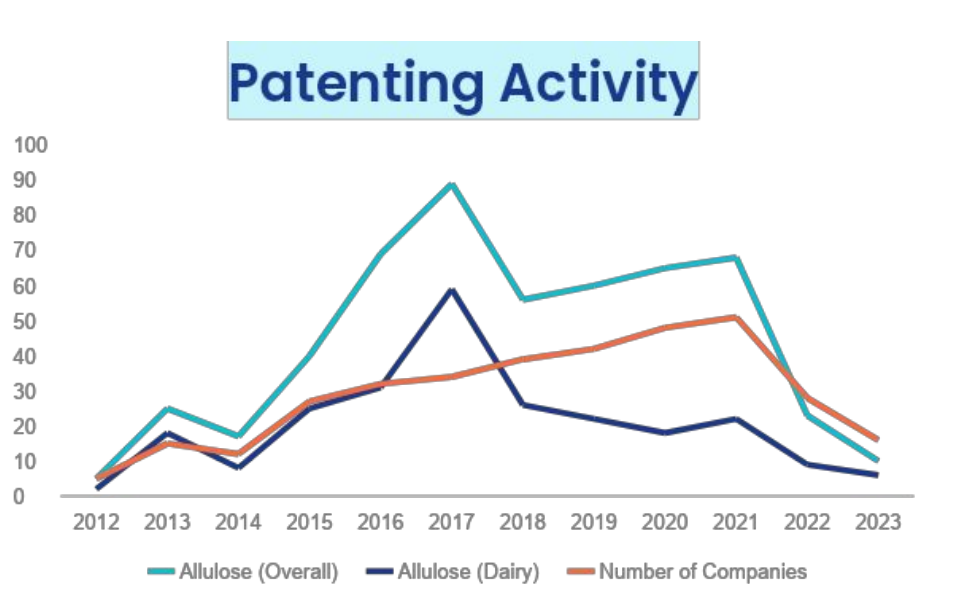
Given Allulose’s benefits, an increase in research and patent activity for this sugar alternative was expected anyway. The level of patenting activity increased by approx. 1.5 times, whereas there was a 45% increase in new product development in food and beverages utilizing Allulose.Key findings from patent research: a) Patenting activity in allulose and dairy products has increased exponentially since 2014-15. b) Interestingly, the number of companies filing patents w.r.t Allulose rose in 2015, but it has been more or less stagnant since then.
This indicates that the same number of companies have started filing more patents w.r.t. Allulose, suggesting they are seeing Allulose as a potential solution. c) Another noteworthy point is that a lot of research has been done on Allulose from South Korea, followed by the United States. This is because Samyang Corporation has been selling Allulose since 2017, initially under the brand “Trusweet,” and currently supplies it to beverage, ice cream, and dairy companies in Korea. Another company, CJ Cheiljedang, has been working on Allulose for quite some time now and has launched products such as AllSweet™ Allulose Low-Calorie Sugar.
Is Allulose consumer acceptable?
Many people have praised allulose for being natural, gentle on the digestive system, chemical-free, and possessing great flavor. They also confirm that it has a similar taste to regular sugar. The U.S. Food and Drug Administration also classifies allulose as “generally recognized as safe” (GRAS). It recently ruled that it would be excluded from total- and added-sugar counts on nutrition labels, making the labels more user-friendly.
However, some dietitians are still skeptical and cautious about using Allulose, considering the side effects. Like many lab-made products, Allulose has potential side effects. If consumed in large quantities, it may cause abdominal discomfort, excessive gas, or diarrhea. More studies are needed to understand its long-term safety and potential side effects.
The full report discusses how Allulose can become a commercial sweetener that replaces sugar, the innovators in this area, and potential roadblocks to consider. Fill out the form below to access the comprehensive guide on Sugar Reduction Solutions.

Can tagatose replace cane sugar?
Tagatose is a rare sugar derived from natural sources such as milk. Biospherics Incorporated developed and filed a patent, US5356879A, for D-Tagatose in 1992, which they licensed to MD Foods in 1997. MD Foods merged with the Danish-Swedish multinational cooperative Arla Foods in 2001.
The following year, Arla Foods announced that tagatose secured FDA GRAS (Generally Recognized As Safe) status, making it ready for sale in the US. Diet Pepsi was the first commercial product to contain tagatose, and the European Union approved tagatose as a new food ingredient in 2005.
Commercialization of tagatose
Despite its initial popularity, tagatose production declined in 2006 due to the high cost of manufacturing. Eventually, a subsidiary of Damhert, Nutrilab, bought up Arla’s remaining Tagatose supply and launched its own products. In 2007, they launched their branded sweetener, Tagatesse, marketed as a sugar alternative. When Damhert began D-tagatose production in 2007, they modified the production process. However, foods with this sweetener remained for those with expensive tastes.
Interestingly, in January 2023, a startup named Bonumose LLC announced a breakthrough in manufacturing this sweetener. Instead of costly milk-based ingredients, Bonumose uses affordable, widely available plant-based ingredients. Its processing technique is relatively low-cost and enzymatic, yielding remarkably high outputs.
Industry leaders see Tagatose as a promising alternative.
Several prominent industry leaders, like Hershey’s, ASR Group, and Symrise Flavors, have expressed interest in Tagatose. As the world’s largest cane sugar refiner and marketer, ASR Group invested in Bonumose, Inc. in February 2021. As of July 2023, Symrise Flavors has signed a minority investment agreement with Bonumose. Hershey’s, too, invested in Bonumose, enabling it to set up a $27.7 million, 36,000-square-foot manufacturing plant.
This sugar substitute demonstrates several health benefits for weight control. However, the FDA refused to exempt it from the “Added Sugar” label, mainly due to its high caloric density (40% of calories are from sugar). In contrast, allulose boasts only 10% of the calories as in sugar. Regardless, Hershey’s investment in Bonumose’s Tagatose solutions hints at a potential range of commercial products featuring its health benefits in the future.
Can the sugar modification technique of converting milk sugar to GOS replace sugar in dairy products?
Another mechanism mentioned earlier was sugar modification. This section will discuss whether converting milk sugar to GOS can replace sugar in dairy products. DuPont’s noteworthy news in this area is the launch of a new flagship dairy enzyme that enables a 35 percent or more reduction in total sugar.
While standard lactase breaks down the milk sugar lactose into its component parts of glucose and galactose, Nurica transforms galactose into Galactose Oligosaccharides (GOS). This is a prebiotic dietary fiber that can ultimately reduce milk sugar levels, with the extent dependent on the lactose content of the matrix.
What is the status of research on this method of converting milk sugar to GOS?
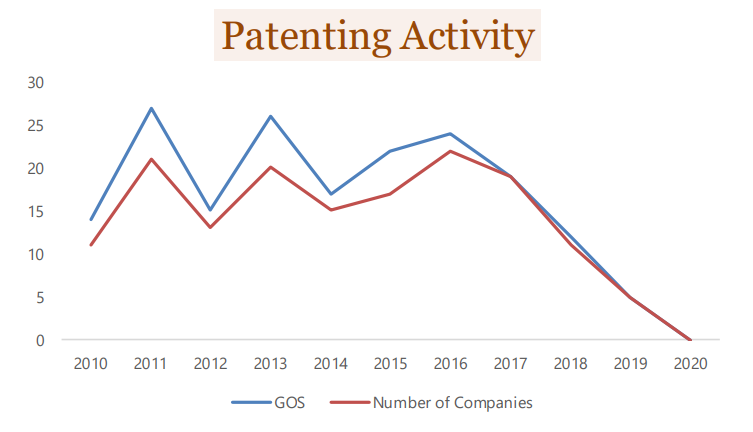
The patenting activity on the enzymatic conversion of lactose into GOS has not increased much in the last few years (ignoring 2018-20, as the patents might not have been published yet). However, there has been significant activity on the research paper side, where many universities, such as Tuscia University of Italy and
The University of Lahore has researched the capability of different enzyme variants to convert lactose into GOS. The reason for increased research seems simple—converting lactose into GOS helps reduce sugar content and makes the end product more relevant to lactose-intolerant consumers. That said, enzyme manufacturers have been the significant patent filers here, and they see this as an opportunity. Companies like DuPont and Novozymes have touted their enzymes, claiming they can reduce sugar by 25-35%, even in yogurt.
How are consumers treating the method of converting milk sugar to GOS?
The good news for manufacturers and companies planning to pioneer the conversion of milk sugar to GOS is that various health organizations have already accepted its use in food products. GOS are among the non-digestible oligosaccharides (NDOs) with prebiotic properties and are licensed as FOSHU (Foods for Specified Health Use) food additives by the Japanese Ministry of Health.
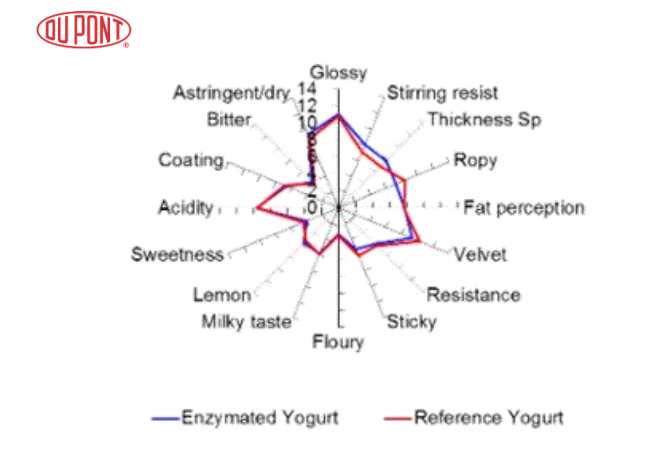
Further, GOS is GRAS-approved by the U.S. FDA. The EFSA has also substantiated health claims for GOS, including relief of gastrointestinal discomfort and reduction in pathogenic microorganisms. That said, the results from different companies’ marketing enzymes for producing GOS have been noteworthy. For example, the DuPont stats are given below. It can be observed that the differences in properties between regular yogurt and enzyme-treated yogurt are minimal.
A survey was conducted to identify consumer perception. At least 500 respondents were selected from each of the following six countries: Thailand, South Korea, the US, Brazil, Germany, and the UK. All participants consumed dairy products regularly. The survey results are available exclusively in the complete report.
Choosing the best solution for the sugar reduction technology problem?
Given the ongoing research in this field, this article provides only a brief overview of the information needed to select a suitable sugar-reduction technology. The comprehensive sugar reduction landscape report answers all questions concerning research activity, top patent filers, and actionable next steps to pioneer this domain. Use the report to analyze and select the best reduced-sugar solutions that meet your requirements. Fill out the form below to receive a copy directly to your inbox!
What are the challenges in the current Sugar Reduction Solutions?
There are challenges associated with sugar reduction, as alternatives that help reduce sugar come at a cost. These alternatives/substitutes can have an impact on any or more of the following –
Flavor
Sugar is sometimes used as a masking agent in certain foods. When sugar content is reduced, the flavor profile of such food items is disturbed. Moreover, certain sugar substitutes have an unpleasant aftertaste that spoils the overall flavor.
Bulking Effect
Beyond sweetness, sugar also adds bulk to food items. Therefore, replacing sugar with other sweeteners is a significant challenge — because most alternatives are required in small quantities and do not provide any nutritional value or bulking effect to the food items.
Color and Aroma
When heated, sugar caramelizes or undergoes a Maillard reaction, which leads to browning in the presence of proteins. This imparts a golden-brown color and a pleasant aroma to baked goods. This reaction does not occur for alternative sweeteners, and baked items do not exhibit this characteristic color and aroma.
Shelf-life
Most sugar substitutes do not form a stable mixture with food items such as beverages. This instability poorly impacts the shelf life of such food items.
Texture/Mouth-feel
Sugar’s texture and mouthfeel are complex to mimic using substitutes. Eventually, sugar reduction varies the texture/mouthfeel of food items, leading to unsatisfied consumers.
What are the different types of artificial sweeteners and other sugar substitutes?
| High-Intensity Sweeteners | Bulk Sweeteners |
| They have a sweet taste but are non-caloric, add no bulk to food, and are sweeter than sugar. Therefore, it is used at very low levels. | They have a sweet taste but are non-caloric, add no bulk to food, and are sweeter than sugar. Therefore, they are used at very low levels. |
| Synthetic Examples: Aspartame, Sucralose | Caloric Examples: Sucrose, Molasses, Honey and Maple Syrup, Glucose, Fructose |
| Semi-Synthetic Examples: Neohespiridine dihydrochalcone | Low-Caloric Examples: Sorbitol, Xylitol, Allulose |
| Natural Examples: Fruit sugars, Stevioside, Glycyrrhizin, Thaumatin |
How Can We Help You?
We support industry-leading R&D and Innovation professionals through complex problems. Describe your challenge, and let us bring clarity and expertise.
How Can We Help You?
We support industry-leading R&D and Innovation professionals through complex problems. Describe your challenge, and let us bring clarity and expertise.